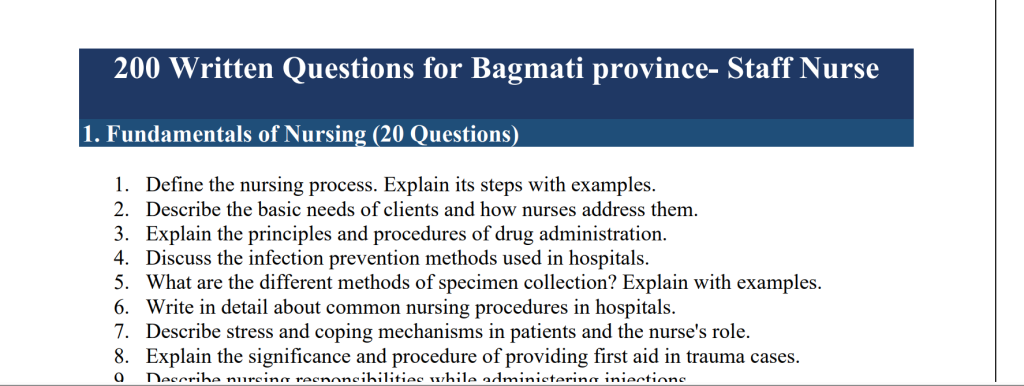
200 Written Questions for Bagmati province- Staff Nurse
1. Fundamentals of Nursing (20 Questions)
- Define the nursing process. Explain its steps with examples.
- Describe the basic needs of clients and how nurses address them.
- Explain the principles and procedures of drug administration.
- Discuss the infection prevention methods used in hospitals.
- What are the different methods of specimen collection? Explain with examples.
- Write in detail about common nursing procedures in hospitals.
- Describe stress and coping mechanisms in patients and the nurse’s role.
- Explain the significance and procedure of providing first aid in trauma cases.
- Describe nursing responsibilities while administering injections.
- How does a nurse ensure patient safety in a hospital setting?
- Explain the importance of hand hygiene and sterilization in nursing practice.
- Discuss nursing documentation and its importance in patient care.
- Write short notes on bed making and pressure sore prevention.
- Describe the preparation and aftercare of a surgical patient.
- Discuss the role of a nurse in pain assessment and management.
- What ethical principles guide nursing practice?
- Explain the role of a nurse in managing IV fluids and electrolytes.
- Write in detail about communication skills in nursing care.
- Explain how a nurse can contribute to health promotion in hospitals.
- Describe how a nurse handles emergency situations like cardiac arrest.
II. Applied Science (20 Questions)
- Describe the structure and function of the cardiovascular system.
- Explain the mechanism of osmosis and diffusion with examples.
- Discuss the physiology of respiration and related nursing interventions.
- Write about the acid-base balance and the nurse’s role in monitoring it.
- Explain the principles of Newton’s laws and their application in nursing care.
- Describe the signs, symptoms, and management of fluid and electrolyte imbalance.
- Write about the skeletal system and common disorders.
- Discuss the importance of rehydration therapy and its application.
- Explain different types of microorganisms and their roles in disease.
- Describe the causes, symptoms, and prevention of common infectious diseases.
- Discuss nursing management in patients with fever and infection.
- What is the significance of diagnostic investigations in nursing care?
- Explain the concept of immunity and types of immunity.
- Write short notes on bacterial culture and antibiotic sensitivity tests.
- Explain nursing implications in administering commonly used drugs.
- Describe the side effects and precautions of using antibiotics.
- Discuss how friction and gravity impact patient movement and transfers.
- Explain homeostasis and its importance in human physiology.
- Write in detail about the urinary system and its common pathologies.
- Describe the gastrointestinal system and implications of digestive disorders.
- III. Medical/Surgical Nursing (30 Questions)
- Describe pre- and post-operative care of a surgical patient.
- Explain nursing management of patients with head injury.
- Discuss causes, symptoms, and nursing care of meningitis.
- Write in detail about nursing care in asthma and bronchitis.
- Explain nursing management in tuberculosis patients.
- Describe common nursing diagnoses for patients with cardiac arrest.
- Discuss the nursing care of patients with diabetes mellitus.
- Explain nursing management in hypertension.
- Describe causes, symptoms, and nursing care of renal failure.
- Explain nursing interventions in gastrointestinal disorders like peptic ulcer.
- Write about the care of patients with fractures and dislocations.
- Discuss nursing care for patients with hernia and hydrocele.
- Explain the nursing process in the care of patients with epilepsy.
- Discuss nursing management of a patient with urinary tract infection.
- Write about the care of patients with hepatic conditions like cirrhosis.
- Describe the role of a nurse in caring for patients with anemia.
- Discuss the care of a patient with appendicitis.
- Explain nursing care in peritonitis and intestinal obstruction.
- Describe the management of congestive heart failure.
- Write short notes on osteomyelitis and its nursing management.
- Discuss the significance of nursing assessment in post-operative care.
- Explain the role of a nurse during blood transfusion.
- Describe the care of a patient with gangrene.
- Discuss the pathophysiology and nursing management of myocardial infarction.
- Explain the differences in care for acute vs. chronic conditions.
- What is the nurse’s role in preventing hospital-acquired infections?
- Discuss postural techniques in nursing for bedridden patients.
- Describe care of patients with leukaemia.
- Explain nursing interventions for patients with bladder stones.
- Discuss the challenges and care strategies in spinal cord injury.
- IV. Community Health Nursing (20 Questions)
- Define primary health care and its components.
- Describe the epidemiological triad with examples.
- Discuss the nurse’s role in immunization programs.
- Explain the classification and prevention of communicable diseases.
- Describe indicators of community health status.
- Write about nutritional deficiencies prevalent in Nepal and their management.
- Explain the importance of family planning and the nurse’s role.
- Discuss waterborne diseases and prevention strategies.
- Describe how to conduct a community health assessment.
- Explain the nurse’s role in health education.
- Discuss steps in outbreak investigation.
- Describe the importance of community participation in health promotion.
- Write about the cold chain system and vaccine storage.
- Explain the role of FCHVs in community health.
- Discuss health promotion strategies for adolescent health.
- Describe maternal and child health programs in Nepal.
- Write about the Integrated Management of Childhood Illness (IMCI) strategy.
- Discuss environmental sanitation and public health implications.
- Explain the role of community health nurse in pandemic control.
- Describe health communication tools used in communitie
- V. Midwifery (20 Questions)
- Describe the anatomy and physiology of the female reproductive system.
- Explain antenatal care and the nurse’s role.
- Write in detail about postnatal care and complications.
- Discuss nursing management of high-risk pregnancies.
- Describe minor and major disorders during pregnancy and their management.
- Explain pregnancy-related diseases and their care.
- Write about the steps of normal delivery.
- Describe care of newborn including assessment and breastfeeding.
- Discuss breast care during pregnancy and lactation.
- Describe danger signs during pregnancy and immediate actions.
- Explain the APGAR score and its significance.
- Describe active management of the third stage of labor.
- Write about complications of labor and delivery.
- Discuss management of postpartum hemorrhage.
- Describe nursing responsibilities in cesarean section.
- Explain the nurse’s role in counseling pregnant women.
- Write about neonatal resuscitation.
- Discuss infections during pregnancy and their prevention.
- Describe breastfeeding techniques and problems.
- Explain the national safe motherhood program.
114.
- VI. Gynaecological Nursing (10 Questions)
- Describe the causes and management of uterine bleeding disorders.
- Discuss cystocele and rectocele and their surgical interventions.
- Explain uterine prolapse: causes, stages, and management.
- Write in detail about vesicovaginal fistula.
- Describe nursing care for patients with HIV/AIDS.
- Explain infertility, causes, and nursing interventions.
- Discuss prevention of sexually transmitted infections.
- Write about post-abortion care.
- Explain nursing assessment in gynecological surgeries.
- Describe endometriosis and its nursing management.
- VII. Pediatric Nursing (20 Questions)
- Describe developmental milestones in children.
- Discuss the role of a nurse in adolescent health care.
- Explain the six major killer diseases in children.
- Write about immunization schedule for children in Nepal.
- Describe management of acute respiratory infections in children.
- Explain malnutrition in children and its management.
- Discuss common childhood hazards and their prevention.
- Describe congenital disorders and nursing care.
- Write about child abuse and nursing intervention.
- Explain how nurses reduce child mortality.
- Discuss nursing care of children with diarrhea.
- Describe nursing care for febrile seizures in children.
- Explain juvenile diabetes and its management.
- Write about care of neonates in NICU.
- Discuss the concept of family-centered care in pediatrics.
- Describe role of play in child development.
- Write about breast feeding and weaning practices.
- Explain adolescent mental health and counseling.
- Discuss nutritional needs of children at different stages.
- Describe nursing care for critically ill children.
VIII. Mental Health Nursing (10 Questions)
- Define mental health. Describe classifications of mental disorders.
- Write about the management of schizophrenia.
- Describe nursing care for patients with depression.
- Explain characteristics of mentally ill patients.
- Discuss the role of family in mental health care.
- Describe the importance of therapeutic communication in psychiatry.
- Write about substance abuse and nursing responsibilities.
- Explain bipolar disorder and nursing interventions.
- Discuss nursing responsibilities in suicide prevention.
- Describe anxiety disorders and their management.
IX. Nursing Management & Leadership (20 Questions)
- Define leadership and explain types of leadership styles.
- Describe supervision and its principles in nursing.
- Explain the management cycle in a hospital.
- Discuss motivation theories relevant to nursing management.
- Describe the organizational structure of health services in Nepal.
- Write about national health plans and policies.
- Explain communication process and barriers in healthcare.
- Describe the importance of delegation in nursing management.
- Discuss performance appraisal and its process in nursing.
- Explain budgeting in hospital management.
- Describe quality assurance in nursing services.
- Write about inventory management in a health facility.
- Discuss legal and ethical issues in nursing management.
- Describe change management in health systems.
- Explain the nurse’s role in policy implementation.
- Describe the use of SOPs and protocols in nursing services.
- Explain time management strategies for nurses.
- Write about staff scheduling in health institutions.
- Discuss human resource management in hospitals.
- Describe the role of nursing managers in disaster preparedness.
सामान्य ज्ञान र प्रशासनिक दक्षतामा आधारित दीर्घ प्रश्नहरू (१७१–२००)
१७१. नेपालको स्वास्थ्य प्रणाली र सेवा संरचना वर्णन गर्नुहोस्।
१७२. नेपालको संविधानमा उल्लेखित स्वास्थ्यसम्बन्धी अधिकारहरू विस्तृत रूपमा वर्णन गर्नुहोस्।
१७३. विपद् व्यवस्थापनमा स्वास्थ्य सेवाको भूमिका र नर्सको जिम्मेवारीबारे वर्णन गर्नुहोस्।
१७४. दिगो विकास लक्ष्य (SDG) हरूमा स्वास्थ्यसम्बन्धी लक्ष्यहरू र त्यसमा नर्सहरूको भूमिका स्पष्ट गर्नुहोस्।
१७५. सार्वजनिक स्वास्थ्य चेतना अभिवृद्धिका लागि सञ्चालित कार्यक्रमहरू र त्यसमा नर्सहरूको भूमिका वर्णन गर्नुहोस्।
१७६. स्वास्थ्य सेवामा सूचना प्रविधिको प्रयोग र त्यसको महत्व स्पष्ट गर्नुहोस्।
१७७. नेपालमा मानसिक स्वास्थ्यसम्बन्धी ऐन, नियम र नीति तथा त्यसको प्रभावबारे वर्णन गर्नुहोस्।
१७८. नेपालमा स्वास्थ्य सेवा क्षेत्रका लागि वित्त व्यवस्थापन प्रणालीबारे वर्णन गर्नुहोस्।
१७९. स्वास्थ्य तथा जनसंख्या मन्त्रालयको संरचना र कार्यबारे विस्तृत वर्णन गर्नुहोस्।
१८०. अस्पतालमा कार्यालय व्यवस्थापनका सिद्धान्तहरू र नर्सको भूमिका उल्लेख गर्नुहोस्।
१८१. नर्सहरूले गर्ने तथ्यांक संकलन, व्यवस्थापन र प्रतिवेदन तयारीबारे वर्णन गर्नुहोस्।
१८२. अस्पतालमा अभिलेख राख्ने प्रक्रिया, महत्व र प्रकारहरू स्पष्ट गर्नुहोस्।
१८३. अस्पतालमा आधिकारिक पत्राचार (correspondence) गर्ने तरिका र प्रक्रिया वर्णन गर्नुहोस्।
१८४. अभिलेख वर्गीकरण र संग्रह समयावधिबारे स्पष्ट गर्नुहोस्।
१८५. स्वास्थ्य सेवामा नागरिक बक्तव्य (Citizen Charter) को अर्थ, आवश्यकता र प्रभाव वर्णन गर्नुहोस्।
१८६. नर्सिङ पेशामा अपेक्षित नैतिक व्यवहार (ethical behavior) का उदाहरणसहित वर्णन गर्नुहोस्।
१८७. स्वास्थ्य सेवामा गोपनीयताको महत्व र नर्सहरूको जिम्मेवारी वर्णन गर्नुहोस्।
१८८. स्वास्थ्य सेवा क्षेत्रमा टिम वर्क (teamwork) को आवश्यकता र त्यसको प्रभावबारे वर्णन गर्नुहोस्।
१८९. स्थानीय तहमा स्वास्थ्य योजना बनाउने प्रक्रिया र नर्सहरूको भूमिका वर्णन गर्नुहोस्।
१९०. नर्सहरूको तालिम तथा व्यावसायिक विकास प्रक्रिया र त्यसको महत्त्व उल्लेख गर्नुहोस्।
१९१. राम्रो प्रतिवेदनको संरचना, लेखन प्रक्रिया र विशेषताहरू वर्णन गर्नुहोस्।
१९२. कार्यालय व्यवस्थापनमा फाइलिङ प्रणालीको प्रकार, महत्व र प्रक्रिया उल्लेख गर्नुहोस्।
१९३. स्वास्थ्य क्षेत्रमा सेवा प्रवाहमा देखिने चुनौतीहरू र समाधान उपायहरू वर्णन गर्नुहोस्।
१९४. स्वास्थ्य संस्थामा समस्या समाधान प्रक्रिया र कदमहरू वर्णन गर्नुहोस्।
१९५. अस्पतालमा गुनासो व्यवस्थापन प्रणाली र त्यसमा नर्सको भूमिका वर्णन गर्नुहोस्।
१९६. नर्सिङ सेवामा सेवा उत्कृष्टता (Service Excellence) को अवधारणा र लागू गर्ने तरिका वर्णन गर्नुहोस्।
१९७. संप्रेषण (Communication) मा देखिने अवरोधहरू र समाधान उपायहरू स्पष्ट गर्नुहोस्।
१९८. नर्सिङ सेवामा सामग्री व्यवस्थापन र भण्डारण नियन्त्रण प्रविधिहरू वर्णन गर्नुहोस्।
१९९. स्वास्थ्य सेवा क्षेत्रमा लागू हुने नैतिकता (ethics) र मान्यताहरूबारे चर्चा गर्नुहोस्।
२००. नर्सहरूको निरन्तर व्यावसायिक विकास (CPD) को आवश्यकता, लाभ र कार्यान्वयनका उपायहरू वर्णन गर्नुहोस्।
DOWNLOAD PDF HERE